The intent of your ideal customer persona is becoming more relevant when creating content and even when optimizing existing content. Understanding user intent, then keyword intent and how it relates to the sales funnels is more important now. Is will help increase your online visibility, directing your visitors in the right direction and eventually to conversion.
We’ll go through the four types of keyword intent, how they fit into the buyer’s journey (TOFU, MOFU, BOFU), and give you some actionable tips on how to research and implement them.
Contents
- What is Keyword Intent?
- The Four Types of Keyword Intent
- How Keyword Intent Aligns with the Sales Funnel
- Top of Funnel (TOFU): Awareness Stage
- Middle of Funnel (MOFU): Consideration Stage
- Bottom of Funnel (BOFU): Conversion Stage
- Practical Tools & Tips for Keyword Research
- Conclusion
- FAQs
- References
What is Keyword Intent?
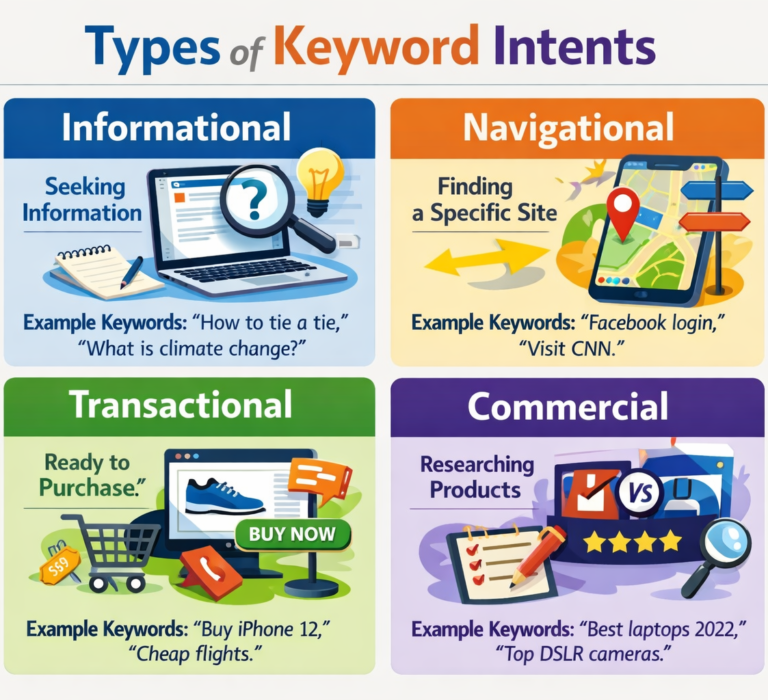
Keyword intent, also called “search intent”, refers to the purpose behind a user’s search query. It tells us what the person is hoping to find, do, or learn when they use these words in their search. By understanding intent, we can create content that meets users where they are in their journey, leading to better engagement, rankings, and conversions. There are four main types of intent, information, navigational, commercial and transactional.
The Four Types of Keyword Intent
1. Informational Intent
Informational intent means the user is looking to learn more about a topic, product, or service, answer a question, or explore something new. They’re not ready to buy, yet, they just want information. These searches often include words like “what is,” “how to,” or “why.”
2. Navigational Intent
Navigational intent means the user is looking for a specific brand, website, or location. They’re not searching to learn something new or compare, they know where they want to go or what they want. They just need help getting there.
3. Commercial Intent or Investigational Intent
Commercial intent shows that the user is at the stage of researching before making their purchase. They’re comparing products, reading reviews, or looking for the best value. These searches often contain “best,” “vs,” “reviews,” or “top 10.”
4. Transactional Intent
Transactional intent means the user is ready to take action, usually to buy something, sign up, or make a booking. These are high-converting queries and often include phrases like “buy,” “order,” “discount,” or “subscribe.”
How Keyword Intent Aligns with the Sales Funnel
Here’s how each type of intent corresponds to a stage of the marketing funnel:
| Funnel Stage | User Goal | Keyword Intent(s) | Content Type |
| TOFU | Learn or explore | Informational | Blog posts, guides, how-tos |
| MOFU | Compare & consider | Commercial + Navigational | Reviews, comparisons, brand pages |
| BOFU | Buy or take action | Transactional | Product pages, CTAs, offers |
Top of Funnel (TOFU): Awareness Stage
Goal: Build awareness and educate
Keyword Intent: Informational
Characteristics:
- Broad, general questions
- Educational and informative
- Often long-tail, low competition
Example Queries:
- “What is matcha?”
- “How to clean a BBQ”
- “Why is Pilates good for posture?”
Research Tips:
- Use question type words like “how to”, “what is”, “why”.
Middle of Funnel (MOFU): Consideration Stage
At this stage, users are actively exploring their options. They aren’t ready to purchase yet but they are comparing, researching, or navigating toward solutions. MOFU search intent is split into two types: Commercial and Navigational.
Goal: Nurture interest & guide consideration
Intent Types: Commercial & Navigational
Navigational Intent (MOFU)
Characteristics:
- Brand- or location-specific
- Focused on reaching a known destination
- Often include URLs or platform names
Example Queries:
- “Netflix login”
- “Pilates in Ottawa”
- “Amazon phone cases”
- “Virgin.ca sign in”
- “Club Pilates near me”
- “[Brand] store locator”
Research Tips:
- Use GSC to identify branded queries already driving traffic
- Optimize meta titles and URLs to match common navigational terms
Include store locations, landing pages, and login links where relevant
Commercial Intent (MOFU)
Characteristics:
- Problem-solving or evaluative
- Brand-neutral or broad
- Helps user choose the best fit
Example Queries:
- “Best matcha powder for lattes”
- “Top 10 Pilates studios in Ottawa”
- ”Pixel 9 vs iPhone 14”
- “Matcha benefits vs coffee”
- “Beginner-friendly yoga mats”
Research Tips:
- Use modifiers like “best”, “vs”, “compare”, “top”, “review”
Bottom of Funnel (BOFU): Conversion Stage
Goal: Drive conversions and sales
Keyword Intent: Transactional
Keyword Characteristics:
- High purchase intent
- Action-focused (buy, sign up, get a quote)
- Specific product or service names
Example Queries:
- “Buy ceremonial matcha online”
- “Pilates trial package Ottawa”
- “Matcha powder coupon”
- “Where to order matcha near me”
Research Tips:
- Filter keyword tools by transactional modifiers, “buy”, “sign up”, “purchase”,
- Match to landing pages, service pages, or checkout flows
- Use call-to-actions and benefit-driven content to convert
Practical Tools & Tips for Keyword Research
Regardless of the funnel stage, we need to find and research for keywords.
Tools
- SEMRush / Ahrefs – Great for filtering by intent, volume, and difficulty
- Google Search Console (GSC) – Real user queries for your site
- Google SERP – Use autocomplete, “People Also Ask,” and related searches
Tips
- Use low-volume, long-tail keywords for niche visibility and lower competition
- Don’t ignore zero-volume keywords—they often convert well and appear in AI-powered search features
- Consider business goals. Match business goals with the customer journey and search intent when searching for keywords.
Conclusion
Understanding keyword intent and its relation to the customer journey is the first step of an SEO strategy. Instead of targeting random keywords, align your content to the buyer’s journey:
- TOFU: Use Informational keywords to attract and educate
- MOFU: Use Navigational + Commercial keywords to guide consideration
- BOFU: Use Transactional keywords to convert
This strategy not only improves your rankings but also ensures your content is useful, timely, aligned with what your ideal customer wants and most importantly, business goals.
FAQs
1. What is keyword intent in SEO?
Keyword intent is the reason behind a user’s search—whether they want to learn, compare, or buy. Understanding intent helps you create content that matches what the searcher is looking for.
2. What are the four types of keyword intent?
The four types are:
- Informational (learn something)
- Navigational (find something)
- Commercial (compare options)
- Transactional (take action or buy)
3. Which keyword intent is best for conversions?
Transactional intent is best for conversions because the user is ready to take action, such as buying a product or booking a service.
4. Should I only focus on high-volume keywords?
No. Low- or zero-volume keywords, especially long-tail ones, can bring in highly targeted traffic with lower competition and greater conversion potential.
5. What tools help identify keyword intent?
Tools like SEMRush, Ahrefs, Google Search Console and even Google itself are excellent for researching keywords. You can also use Google to get keyword ideas from autocomplete, people also ask and related questions for more ideas.